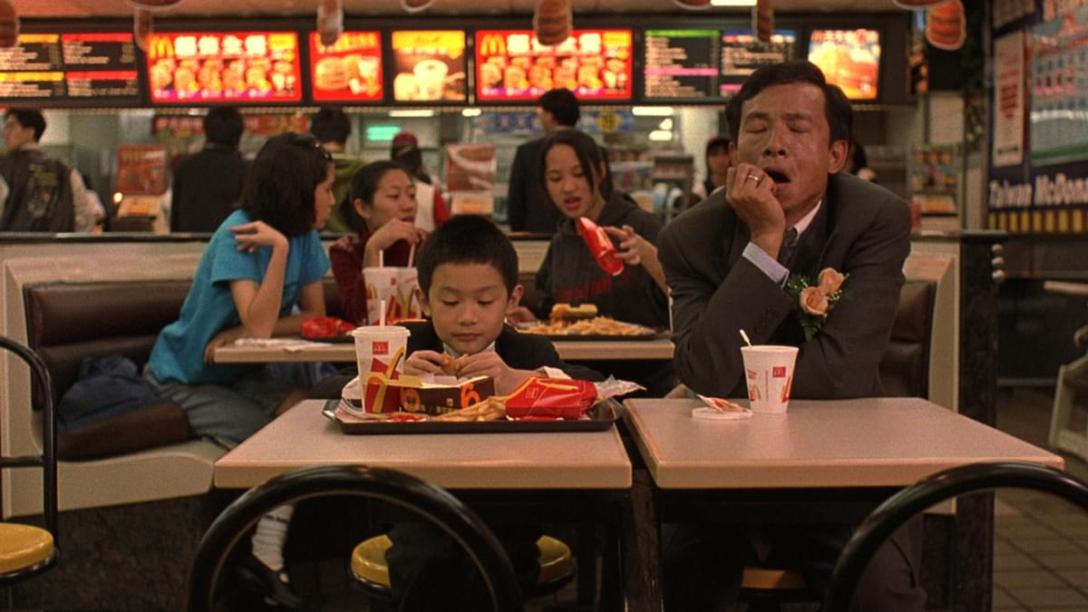
There is a scene that has stayed with me long since watching it. It’s from a 2000 slice-of-life Taiwanese film called Yi Yi. Although the film runs just shy of 3 hours, I left the theater wishing that it was longer. Many of the scenes from this film have continued to linger in my mind. In the one I’m about to share, Ting-Ting — a teenage girl who has just experienced her first heartbreak — is dreaming. In it, her comatose grandmother is awake, and Ting-Ting sets her head in her grandmother’s lap, crying.
Why is the world so different from what we thought it was?
Now that you’re awake and see it again… has it changed at all?
Now I’ve closed my eyes… the world I see… is so beautiful.
I feel like this sentiment resonates with anyone who had the privilege of dreaming about what the world could be like when they were growing up. My mother used to buy me books and movies all the time, and each one would transport me to new worlds teeming with possibilities. Among my favorites were Spirited Away, Pokemon, the Magic Tree House books, and the Frog and Toad books. I’d come away with feelings that would have taken years to surface out of this boring little life of mine. Subsequently, an ever-increasing, glowing sense of excitement about the vast world continued to grow within me.
I’m now in my late 20s. My life hasn’t quite panned out the way I dreamed it would. The world isn’t as perfect or as beautiful as I imagined it’d be, either. Perhaps the images which were implanted in my mind through mere words or drawings on a page left within me a permanent sense of longing for a beauty that can exist only within the mind.
Which brings me to my next question. Is it ethical to tell fictional stories to our children? To tell them about things like Santa and the North Pole, or the Tooth Fairy? To buy them books which contain descriptions and images of things or people imbued with an intangible, magical quality that doesn’t quite exist in the real world?
I ask this because I once heard an interesting point from an atheist who was raised Catholic. He claimed that the indoctrination of children about the existence of Heaven and Hell is grossly inappropriate and unethical. For from an early age, the child must live under the knowledge and fear of eternal damnation. And because the existence of Heaven and Hell cannot be fundamentally disproven, this burden of knowledge will continue to haunt them for the rest of their lives — whether they choose to believe in it or not.
Similarly, the child who is read tales about lands that overflow with milk and honey; of vast flower fields tucked away among valleys of rolling green hills, where the rivers run crystalline blue; of beautiful women (or men) perfect in appearance and in heart; is forever haunted by a nagging sense of longing, an insatiable desire for something beyond.
I present these questions but don’t have a definitive answer. Although I consider myself a Christian, I often wrestle with an innate skepticism that inevitably arises. Stories that were easy for me to believe as a child are much harder for me to believe now. Despite my grown-up understanding of the world’s laws, I still believe that Noah — an ordinary man with zero prior experience in carpentry — built a boat large enough to house two of every species in the world, going on to survive the most devastating flood in the history of the world. Or that Moses split the Red Sea by placing his staff down Gandalf-style.
At the end of the day, I just can’t bring myself to not believe in God, in His son Jesus, in Heaven. I guess I just can’t cope with the idea that this sense of longing which is nestled deep within my heart and has pervaded my entire existence is nothing more than a grand hoax. In order for me to wake up each morning and face the day, I must believe that a day will come when all that is broken in his world will be made right.
My religious beliefs aside, I can recall brief times in my own life where, for even just a moment, I felt that this life was everything that I dreamed and more. Such moments often came from spending time with cherished friends and family, or on trips to new places.
Like a year ago in Japan when, in that brilliant hour of the afternoon, the golden light of the sun broke through the clouds and extended slantwise across the vast horizon. From atop the hill upon which I stood lay a panorama of the town I had just walked through. The paved dirt roads glowed a brilliant yellow, the clay brick walls lining my path now saturated in deep crimson, the enveloping shade of the tree above me equally as radiant as the sun-washed leaves which emanated a warm green hue.
It is in such moments that a sense of utter completion overwhelms me and pervades my entire being. Life’s mysteries unravel before me, the beauty of this world and the joy of living in it joining delicately as a butterfly poised atop a flower.
Such moments come few and far between. Though they are fleeting by nature, I try to cherish them as they come. Whether these childhood stories ultimately deceive us or prepare us for meaning, I still don’t know for sure. Perhaps this sense of longing was never meant to be cured, only carried. So that when moments of magic do arise, we’re transported back to that simple joy we once carried as children.

 marginalia
I think acknowledging the harsh and cruel reality we live in and choosing to reject it to carve your own reality for yourself is what it really means to be brave. For me nothing sounds more miserable than to be caged in a world that was given to me. My humanity and individuality all erased to become another cog in the system that was built by someone else. To accept that this is all that reality can offer me would just be too sad.
LikeLiked by 1 person
Wholeheartedly agree! Beautifully said and I appreciate the comment 🙂
LikeLike