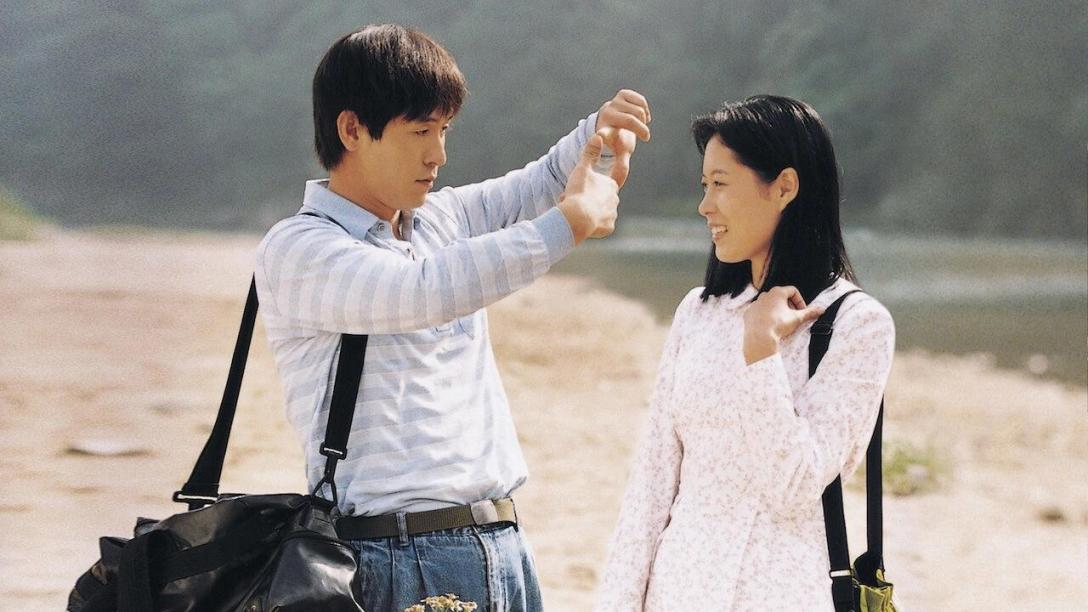
This past month, the books and films I’ve been interacting with have been stirring all kinds of thoughts and feelings within me. A few weeks ago I rewatched Hayao Miyazaki’s Princess Mononoke in theaters, then a week ago finished Vladimir Nabokov’s novel Pnin, then two nights ago, watched Lee Chang-Dong’s film Peppermint Candy for the first time.
I felt like all three works were touching upon one central message, and I haven’t been able to take my mind off what that could be. This is my attempt at distilling those scattered thoughts.
You wrote in that diary, “Life is Beautiful”
Do you really think so?
— Young-ho, Peppermint Candy
Timofey Pnin lost his innocence—and his first love, Mira Belochkin—to the Holocaust and the Russian Revolution. Young-ho lost his to a turbulent South Korean dictatorship and a toxic culture of hyper-masculinity. Both men were victims of forces larger than themselves. Yet their trajectories diverged completely: one completely surrendered his humanity to the violence around him, while the other refused to let it go.
Ancient Greek philosophy divided the concept of time into two: Chronos, the quantitative, linear passage of time, and Kairos, the quality, meaning, and weight of time, especially in the face of death.
Lee Chang-dong’s 1999 film Peppermint Candy is a film that operates within Kairos. Opening with the tragic suicide of the broke, cynical, 40-year-old Young-ho standing on a railroad track before an oncoming train, the film moves backward in time to trace his moral decay. Embedded throughout is the painful history of modern South Korea, from the 1997 Asian financial crisis (or IMF crisis), the brutal military dictatorship of Chun Doo-hwan, and the subsequent Gwangju uprising where thousands of innocent students were killed.
Though Young-ho’s actions throughout the film are deplorable and reprehensible, as the reverse narrative unwinds, we discover a once innocent and gentle young man; someone who once loved photography, held a tender love of nature, and cherished peppermint candies. Forced into compulsory military service and thrust into unwilling violence, he let the trauma inflicted on him lead to a chilling cruelty toward others.
Yet the real tragedy, more than what was done to him, was the choices he made as he moved forward with his life. As Lee Chang-dong noted:
“We live making countless choices in our own time. And if you look back at the time in reverse order, that is, if you look back already knowing the result, you can see the terrifying meaning of the choices that led to that result… I wanted audiences, especially young audiences, to feel the meaning of choices that we make at countless moments in our lives.“
In stark contrast to Young-ho is Vladimir Nabokov’s Professor Timofey Pnin: a displaced émigré living in mid-century America, stripped of everything known and dear to him: his family, his homeland, his status. He is clumsy, outwardly pathetic, and frequently mocked by his peers (all of which I find very, very relatable); the novel starts off with him on the wrong train, completely unaware.
Despite this, what truly defines him is his unyielding warmth and humanity. Unlike Young-ho, who projects his pain outward through abuse and cynicism, Pnin looks directly into the abyss without allowing it to corrupt his soul. He finds joy in small comforts, whether a newly purchased washing machine, a simple evening with friends, or a blue punchbowl gifted by his ex-wife’s son.
One scene in particular deeply affected me. Pnin is conversing with a fellow professor, Hagen, at a little faculty party he’s hosting. He’s celebrating his new home and his bright future (believing that tenure is just around the corner). Yet what he doesn’t yet know is that he’s about to get fired—replaced by the very man who had an affair with his ex-wife. In this tragic context, we see his tender humanity:
“‘Yes,’ said Pnin with a sigh, ‘intrigue is horrible, horrible. But, on the other side, honest work will always prove its advantage. You and I will give next year some splendid new courses which I have planned long ago. On Tyranny. On the Boot. On Nicholas the First. On all the precursors of modern atrocity. Hagen, when we speak of injustice, we forget Armenian massacres, tortures which Tibet invented, colonists in Africa… The history of man is the history of pain!’“
I’ve been thinking about why Studio Ghibli films have always resonated so deeply with me. More than the idyllic scenes, rich details, sweeping soundtracks, and immersive worldbuilding, I think it’s the way the characters are written. There’s no trace of toxic masculinity in the male characters despite having every right to be bitter or hardened.
In Spirited Away, Haku is under the control of Yubaba with no recollection of his past or his true identity. Porco Rosso, due to his wartime trauma, is literally transformed into a pig. Ashitaka, in Princess Mononoke, is struck with a demonic curse that inflicts immense pain and carries a death sentence. The village shaman tells him his fate is sealed. Yet none of these characters choose the destructive path that Young-ho walked.
Ashitaka accepts his reality, but he refuses to succumb to bitterness. He does not harden. He faces a world consumed by war, hatred, and industrial greed, resolving to “see with eyes unclouded by hate.” Even as the curse burns in his arm, driving him toward anger, he repeatedly chooses empathy and understanding.
We cannot choose the historical era we are born into, nor can we always prevent the tragedies that disrupt our lives. Life can completely change in an instant. I have a better understanding now of how true this is for my parents’ generation.
Watching Peppermint Candy helped me to understand my father (and older Korean men for that matter) better; to show him grace in the ways I wished he were different. Reading stories like Pnin and watching Studio Ghibli films helped me to see a new path forward: one which I can aspire toward.
Overall, what these works seem to reveal to me is that when I look back on my life—on my own moments of Kairos—what will matter is not how blameless my circumstances were, but how I responded.
My hope is that I will remain inwardly gentle and outwardly hopeful no matter how dark or twisted the world gets.
Most of all, that I will hold onto empathy for those who couldn’t.


