I think an interesting film is something that you can—you can have an aftertaste. Sometimes when you look at the film, you might not get it at the first time, but somehow it lingers.
– Wong Kar Wai
I love Lee Chang Dong’s work. In light of his new upcoming film Possible Love releasing this fall, I figured that I should finally get around to writing this piece.
Burning has been my favorite film since I first watched it in 2022. I’ve probably rewatched it over a dozen times now. Since starting this blog a year ago, I’ve wanted to dedicate a post to exploring why I’m so drawn to it. But I’ve held myself back time and time again for several reasons:
- No one asked me to.
- It feels so pretentious to call Burning my favorite film, especially when I’m hesitant to recommend it to others.
- I’m self-conscious about being insufferable, and writing a whole essay about why I like something without being asked to is peak insufferable-ness.
But I’ve always been curious about other people’s favorite things. For better or for worse, I read into everything, trying to extract meaning. One’s favorite anything can say a lot about how they view the world and what they value. People sometimes tell me that these small things are never that deep, but I disagree, and I can’t help but interact with the world in this way.
That said, here are some reasons why Burning is currently my favorite film. (Spoilers ahead).
1. the literary allusions
Burning (2018) by Lee Chang Dong is based on a short story by Haruki Murakami called “Barn Burning” (1992), which is loosely inspired by a short story of William Faulkner’s by the same name, “Barn Burning” (1939).
I personally love allusions. I understand why people dislike them, though; Kazuo Ishiguro calls them elitist and disruptive. But in my opinion, an allusion is like a mysterious door in the hallway that is the art you are interacting with. As you explore the hallway, you’ve either entered these doorways before, which then serve to deepen your understanding, or you haven’t—in which case it becomes a delightful invitation to explore, to embark on a scavenger hunt, to come away with a newfound appreciation for and perspective on the work being experienced.
After my first viewing of the film, I had that feeling (it is the best feeling) when you’ve experienced something that you just know is more multi-layered and rich with meaning than you could have extracted from just one sitting. Like a meal which you immediately knew you needed to have again. It is the feeling that defines art that resonates with us.
Eager to make sense of the movie’s themes, I decided to read both short stories. I had already been a fan of Murakami’s writing by then, but I was blown away by the haunting quality of “Barn Burning” despite its brevity. As for Faulkner’s, well, I got extremely lost and confused and discouraged. I decided then that I hated Faulkner’s writing. It wasn’t until a year or two later when I’d revisit him and finally understand why he is so revered. His literature is dark and heavy, always consisting of unspeakable hardship endured by ordinary people. Faulkner gives those people a voice in his work.
After reading and understanding both stories and revisiting the film, I found that I was able to experience it in a new light, and my intrigue for it deepened further.
2. the atmosphere
Lee Chang Dong was able to weave both short stories into one. His film feels like Murakami’s writing turned into a moving picture. It carries the same mystique and aura. It is moody, thrilling, slow-paced, and at times dream-like.
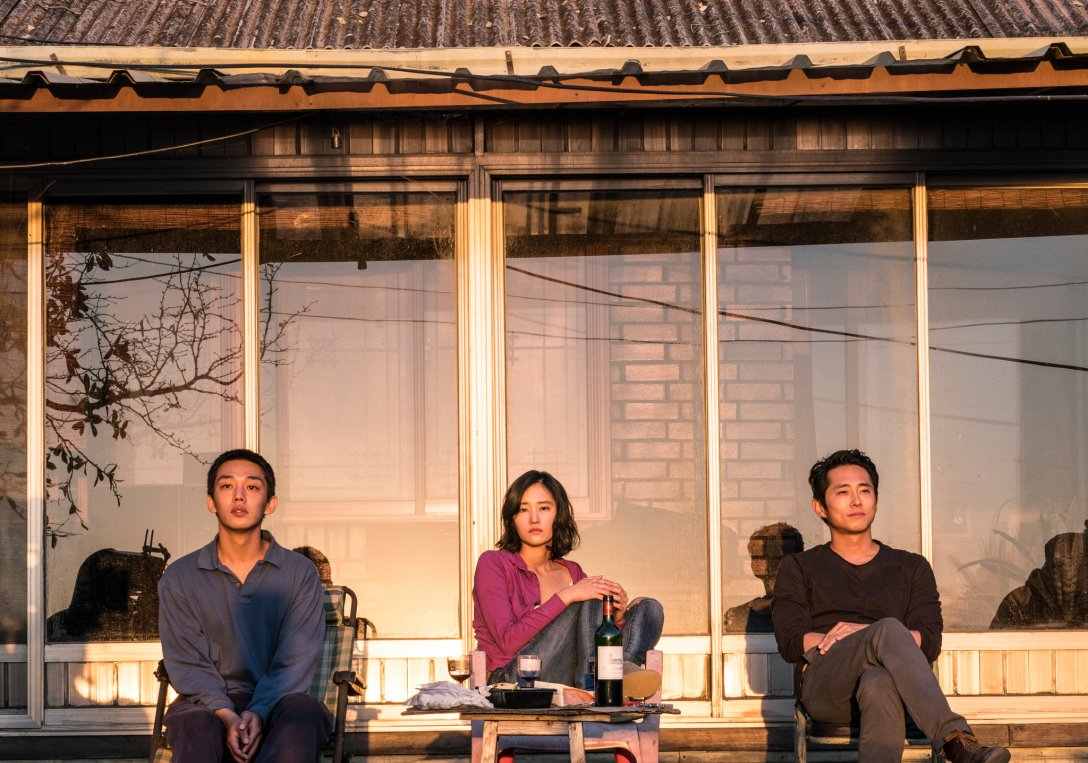
My favorite scene in this regard is when the three of them share a meal at Jongsu’s father’s home in Paju, in the countryside; after some food and wine, a Miles Davis tune starts to play. Haemi performs the “Big Hunger” dance, the Korean flag waving behind her against the backdrop of a rural Korean landscape. This thematically-rich mise-en-scène presents so many contradictions: the flag signals politics and collective identity, the nature in the scene signals the natural world, and Haemi’s dance conveys a desire to be free from all of it. Like the jazz playing in the background, none of these images resolve. They are merely presented for us to sit with.
Later, when Ben and Jongsu smoke pot together and open up, the film somehow conveys that feeling of being high or under the influence. It is a very enrapturing, mystical scene that has stuck with me.
3. the multi-layered metaphors
Greenhouse (비닐하우스). Lee Chang Dong’s subtle change from a barn to a greenhouse for his film is so clever and satisfying to me. If you’ve ever visited Korea’s countryside, you’ve seen them everywhere. There is a lot of intention behind his use of the word. Ben seems to talk about “burning greenhouses” as metaphors for killing disenchanted women; women like Haemi who are drowning in credit debt and victim to societal expectations. A more literal translation of the Korean greenhouse is “plastic house”, and it can also be read as a reference to the plastic surgery industry in Korea. Haemi, like most modern Korean women, was born into a world where she’s expected to be visually perfect and without blemish. This immense pressure is signified by her credit card debt; “being a woman is expensive”. Makeup, plastic surgery, designer clothing, just to be deemed desirable and respected. It’s no wonder she is hungry for a deeper meaning in life, drawn by the idea of “Big” vs “Little” Hunger.
4. the thematic depth
There’s this sense in me that there is something wrong with the world we live in today, as cool and technologically advanced and convenient as it is. I just can’t pinpoint what it is. Like Jongsu, like Abner, I think I secretly carry a rage buried deep within me. It comes up a little when I hear of new homes being pitched as “investment opportunities” rather than places for first-time buyers to have a crack at pursuing their own American Dream. Or when I hear news of AI threatening to take away so many of the jobs we were told to pursue when our eyes were much brighter; jobs which were promised to be great, flourishing careers throughout our lifetime.
It’s the same rage I felt when I watched Jongsu, a poor aspiring writer taking care of his father’s dilapidated country home, driving an old, busted Kei truck, simply desiring to take the girl he loves home, wordlessly concede to her new guy friend the moment he saw Ben’s Porsche parked right beside his truck.
If Haemi is a symbol for the search for meaning in this life, her disappearance midway through the movie shows us what happens when we stop searching. The movie that was always moving toward something suddenly starts to feel aimless and lost. I think there’s a lot to ponder in that alone.
At its core, I think that Burning isn’t just a thriller or a social critique, but also a mirror to our collective “Big Hunger”. It gives form to the deep-seated dread of existing in a modern world that often feels increasingly fragmented and imbalanced.
I believe that there is a bit of us in each of these characters. And I believe that this film does an amazing job of presenting the hard questions we are faced with each day. Each time I watch it, I come away with new insights and more questions. I think that’s what great art does.
I still don’t think I’d recommend Burning to everyone. But I want to stop feeling apologetic about liking it. It’s definitely a heavy movie with serious themes, and most people don’t like to engage with that kind of material, and I hate to be perceived as someone overly serious, but oh well…


